THE BUILDING BLOCKS OF MORALITY
KEY DEFINITIONS FROM WHICH EVERYTHING FOLLOWS
Every argument begins with definitions. If we use the same foundational word but give it different meanings, even perfect reasoning can lead us to completely different places.
Before we can understand Natural Law, Freedom, Rights, or Morality itself, we need to start further back. We must first come to a mutual understanding of the meaning of the foundational words behind these concepts, so we start as far back as we can, right from the beginning.
We start with what exists. Ask what a thing is, what it can do, what limits it, what happens when it functions according to its Nature, and what happens when that flourishing is obstructed.
Then follow the same reasoning into the realm of conscious Moral beings. What it means to perceive Reality, to understand it, to make choices about it, to freely act within it, and to be responsible and accountable for the effects our actions have on it.
From these simple questions, a path begins to form. Nothing is assumed, and each answer gives direction to the next, until ideas that seem unrelated begin to reveal their connection.
Eventually, that path reaches something fundamental about Freedom: SELF OWNERSHIP - The recognition that True Freedom Naturally follows from what a Moral Agent is.
The definitions are simple. What they reveal is not. .
THE FOUNDATION OF
MORALITY and NATURAL LAW
SUBJECTIVE MORALITY
WHERE MORAL RELATIVISM
IS BORN
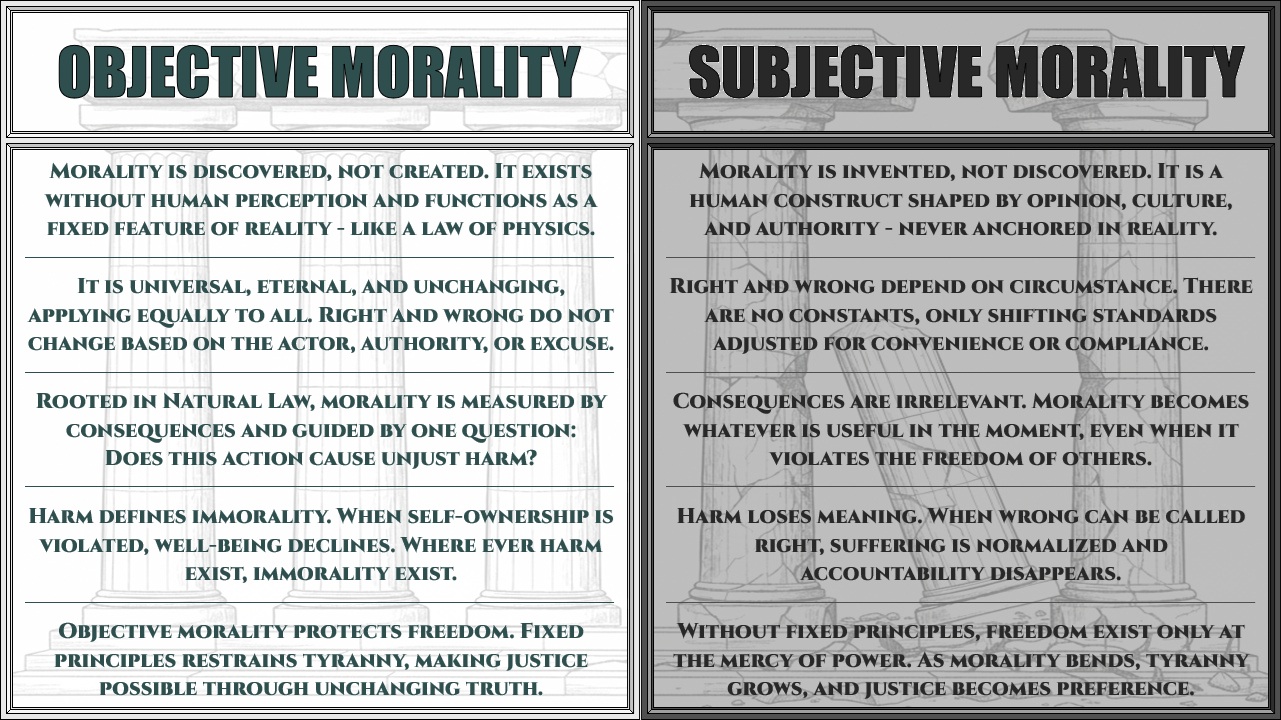
Subjective morality claims that right and wrong depend on opinion, belief, or culture. It appears open-minded and tolerant, but in reality, it destroys the very idea of right and wrong. When morality shifts with perception, truth becomes relative, accountability disappears, and harm can always be justified.
This belief allows violence to be called "discipline", deceit to be called strategy", and tyranny to disguise itself as "order". Relativism removes the line between good and evil, where any action can claim to be righteous. History shows how easily this logic is abused - slavery, censorship, and genocide - all defended and justified as moral duties within their own systems of belief.
When morality is defined by power, it becomes a weapon. Those who rule decide what is "moral", reshaping ethics to protect control and criminalizing dissent. Under such a system, obedience is praised as virtue, while freedom and truth are condemned as punishable acts of rebellion.
Subjective morality does not give rise to autonomy; it is the death of it. It promises tolerance but delivers chaos, blinds humanity to objective truth, and turns morality itself into an illusion. Without an objective moral foundation, justice becomes impossible, and humanity loses its compass entirely.
OBJECTIVE MORALITY
A Universal Standard
Of Right And Wrong
Objective morality is not a belief, but a discovery - a recognition that right and wrong exist beyond culture, opinion, or authority. It does not ask what is accepted or comfortable, but simply what is. Like gravity, it operates whether one agrees or not, and its laws are written into the fabric of reality itself.
At its core stand four immutable principles - Truth, Autonomy, Harm, and Justice. These are not moral preferences but natural constants, forming the foundation of every ethical action. Truth reveals reality as it is, Autonomy protects the freedom to choose, Harm defines the moral boundary, and Justice restores balance when that line has been crossed.
Unlike moral relativism, which shifts with politics and persuasion, objective morality does not bend to power or time. It exposes deception, forbids coercion, and demands accountability. No law or majority can redefine it, because it is bound not to man's will but to Natural Law.
To Live morally is therefore not to obey, but to align - to act in harmony with what is real, fair, and free. Objective morality is the ground beneath all genuine Justice; it is the light that reveals when harm is done and the compass that leads humanity to true freedom.
UNDERSTANDING
NATURAL LAW
Rights and
Their True Source
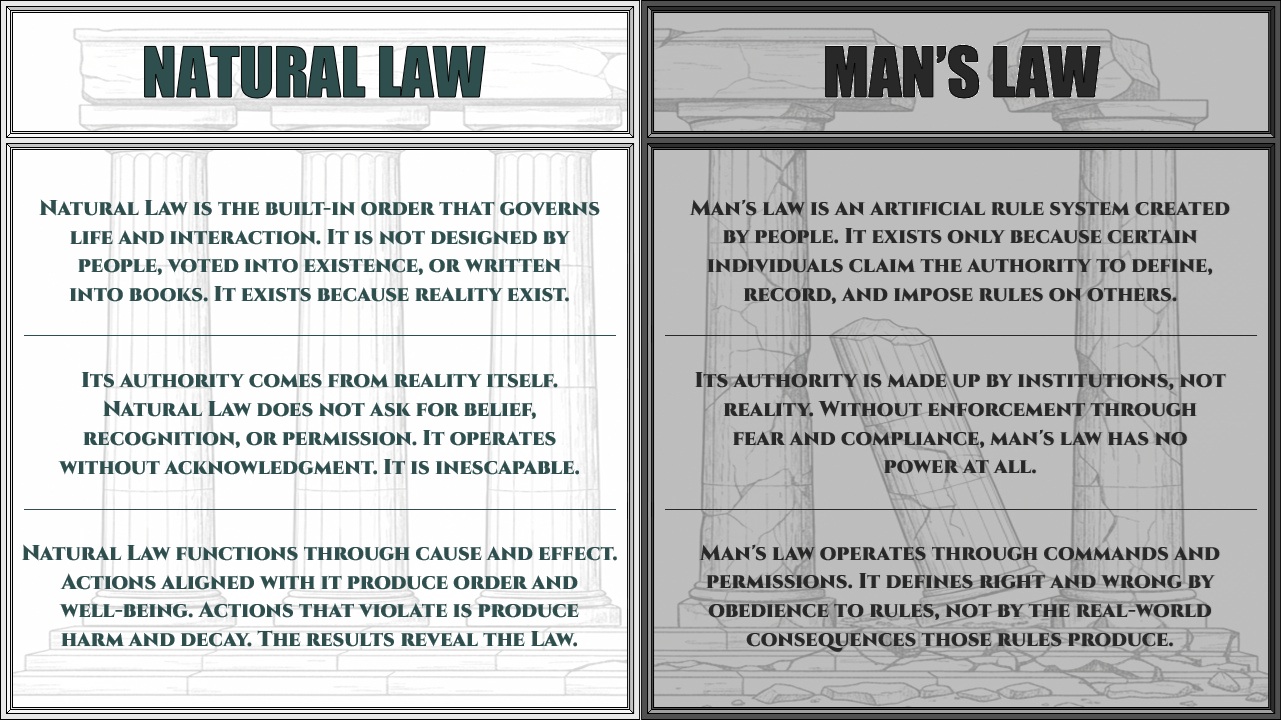
Natural Law is the structure that makes morality real. It is the unseen order behind consequence, the governing principle that links action and outcome. Like gravity or the rules of fire, it exists wihout perception. Touch a flame, you burn - but burning is not punishment, it is consequence. Every choice carries its effect, and no belief or authority can escape that balance.
Where objective morality defines what is right, Natural Law enforces it through cause and effect. It is not a man-made code or social theory, but the moral physics of reality. When we align with it, we create harmony, freedom, and peace. When we violate it, we invite disorder, suffering, and destruction.
From Natural Law arises our Natural Rights - the boundaries of freedom that exists because harm exist. They are not granted by rulers or written in constitutions. They are discovered through conscience and consequence. The right to life, to self-ownership, to truth, and to be free from harm - these are not privileges; they are conditions of existence.
But where Natural Rights are discovered, legal rights are declared - and revoked at will. They are written by those in power, shaped by opinion, and their legality is widely mistaken for morality. Yet what is legal is not always moral, and what is moral is often made illegal. Legal codes imitate Justice, but they limit freedom and call it order - only to serve control. For this reason, morality must always stand above law.
Natural Law is not an idea - it is the reality that governs freedom. It does not wait for belief or recognition, it does not need a signature or a seal, but acts through consequence - a mirror that shows every act for what it truly is. It reveals that freedom is not granted by permission but born naturally through understanding. To live by Natural Law is to step beyond submission of control, to see that no authority stands higher than morality - and no law higher than Natural Law.
PRINCIPLE vs UTILITY
The Axe
That Rules Its Maker
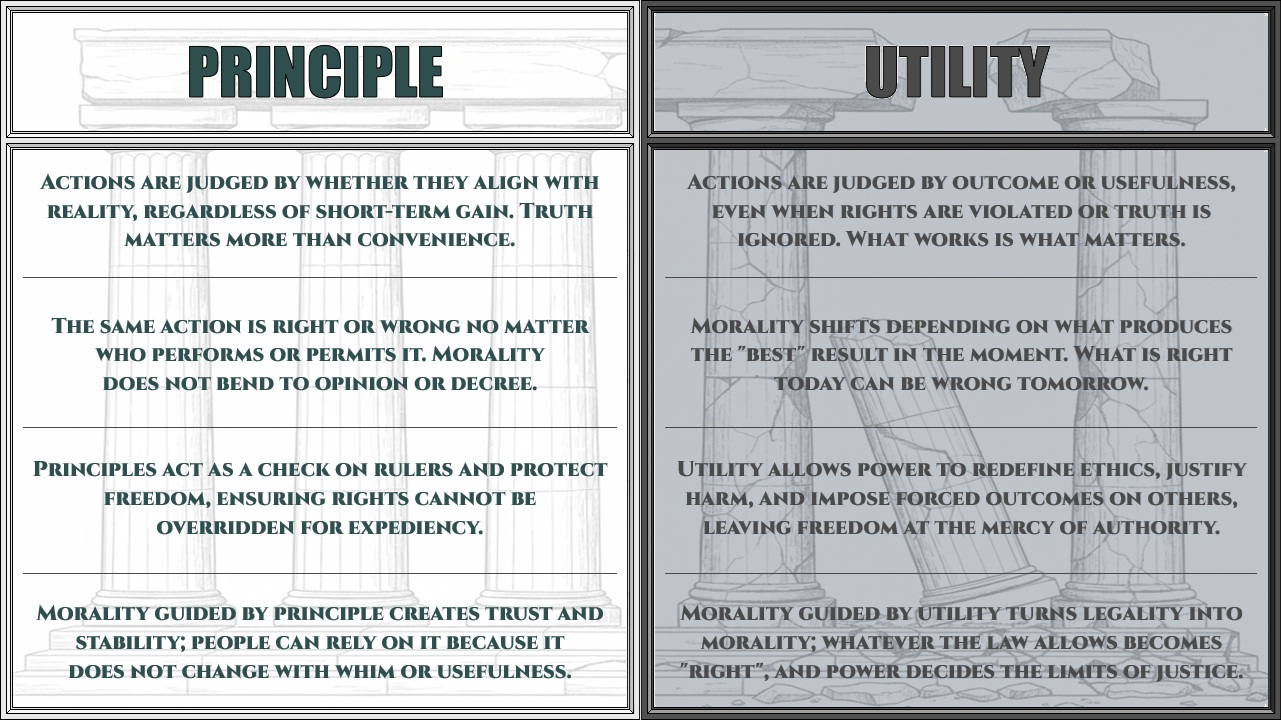
Principle is the compass of morality; utility is the temptation to ignore it. Principle asks, “Is it right?” Utility asks, “Does it work?” One builds freedom, the other builds control.
When action is guided by principle, it aligns with Natural Law — Truth, Autonomy, Harm, and Justice. When action is guided by utility, it serves convenience, fear, or advantage. The moment we trade what is right for what is useful, morality collapses into management, and people become resources in systems designed to serve power.
Utility is seductive because it appears practical. It promises safety, progress, and efficiency — but every empire of oppression began with that promise. When principle is sacrificed, tools become masters. The axe built to serve begins to rule its maker.
A moral tool serves life; an immoral one demands obedience. Governments claim to protect, yet control; corporations claim to innovate, yet exploit; laws claim to preserve order, yet suppress freedom. Each begins as a solution, then rises as an idol. The system once created to serve humanity now expects humanity to serve it.
The question of our time is no longer what we can build, but what we should. Without principle to govern utility, knowledge becomes manipulation, progress becomes plunder, and order becomes tyranny. The measure of any act — or any system — is not its success, but its righteousness.
Principle must always outweigh convenience. Morality must always stand above law, above profit, above fear. The machine must never command its maker, nor utility rule over conscience. To live by principle is to remain free; to live by utility is to become a slave to one’s own creation.